Product Specifications
DEEP DIVE
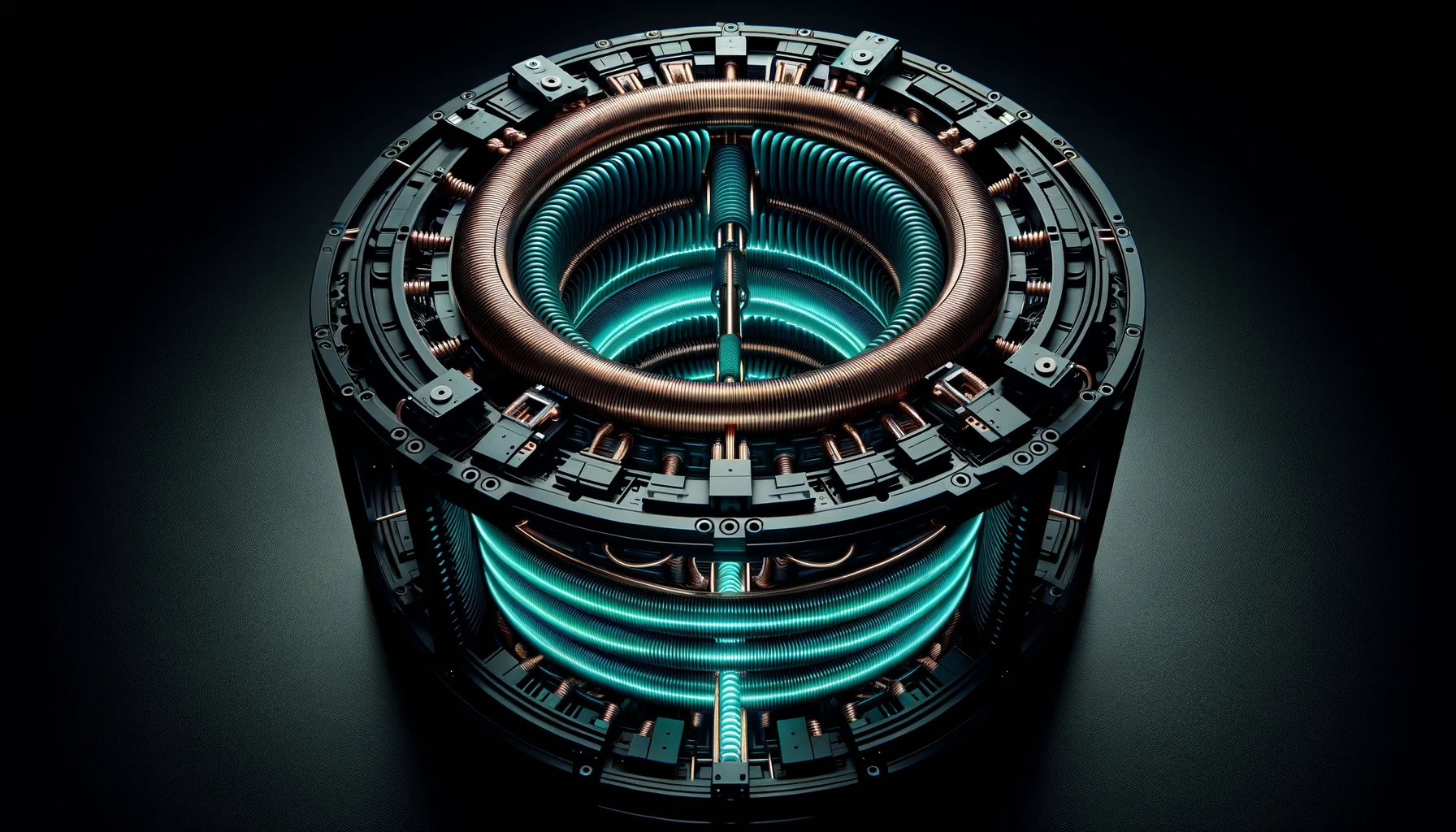
Each tier in the Highfield product line solves a distinct physics problem. The table is a summary. Here is the engineering reality behind each number.
ISO-1 // ENTRY-LEVEL SUPERCONDUCTING SOLENOID
1 Tesla Sustained — The Standard of Perfect Uniformity
The ISO-1 is not defined by its field strength. 1 Tesla is achievable by many vendors. What defines the ISO-1 is its field uniformity: sub-ppm homogeneity over a 50 cm bore volume. This places it in the class of high-end research MRI and NMR magnets, where spatial uniformity directly determines measurement resolution. This requires a Halbach sphere winding configuration with active shimming correction — Hall probe feedback sampled at 100 kHz driving correction coils that cancel thermal drift, vibration, and mechanical creep in real time.
Applications: Clinical and research MRI systems, NMR spectroscopy for pharmaceutical analysis, quantum computing qubit stabilization, and crystal growth in zero-gradient environments. Bore diameter: 50 cm. Cooling: Closed-loop helium or cryogen-free Stirling cryocooler. Operating temperature: 4.2K (LHe) or 20K (cryocooler mode).
CRYO-10 // MID-RANGE PERSISTENT-MODE MAGNET
10 Tesla — The Field You Can Carry
At 10 Tesla, magnetic pressure reaches 400 atmospheres. That is four times the pressure at the deepest ocean trench. Maintaining this field continuously, without liquid helium, in a chassis the size of a Pelican case — that is the CRYO-10's engineering achievement. No-insulation REBCO winding eliminates hot spots: current reroutes around any fault zone through turn-to-turn contact resistance rather than concentrating. Diamond heat spreaders transfer thermal load to a solid-state Stirling cryocooler operating at 20K. Persistent-mode switch locks the field indefinitely with zero power draw once ramped.
Applications: Particle accelerator dipole magnets (bending and focusing), fusion plasma confinement assist coils, compact NMR for field deployment, high-gradient magnetic separation in industrial materials processing, and the CRYO-10 Array used in H-LEV Halbach "Screamer" levitation engines. Cooling method: Closed-loop helium circuit at 4.2K (standard) or cryocooler at 20K (portable variant). Persistent mode stability: <0.1 ppm/hour field drift.
CHRONOS-100 // HIGH-FIELD PULSED MAGNET — "THE IRON HORSE PLATFORM"
100 Tesla Target in 10ms Bursts — Development Platform
100 Tesla is the boundary where conventional magnet engineering ends. At 100T, magnetic pressure hits 4 GPa — beyond the yield strength of copper and most structural steels. The CHRONOS-100 addresses this with two innovations: REBCO tape co-wound with Zylon fiber (stronger than Kevlar, electromagnetically transparent) and nano-defect vortex pinning — engineered crystallographic defects that lock magnetic flux vortices in place, reducing resistive dissipation during the pulse. The current world record for continuous superconducting magnets is 45.5T (Hahn et al., Nature 2019). The 100T target requires pulsed operation (10ms duty cycle) and represents a significant engineering challenge beyond current state of the art.
The CHRONOS-100 is the foundation of the Iron Horse electromagnet platform (see Section 07). Target applications: plasma compression for Stellar Furnace fusion research, high-field materials science (phase transitions, Landau level spectroscopy), and electromagnetic forming of extreme-property alloys. Development roadmap: Phase 1 — 20T sustained (achievable with current REBCO technology). Phase 2 — 50T hybrid (resistive + HTS, comparable to national high-field lab systems). Phase 3 — 100T pulsed (the CHRONOS-100 target, requiring advances in conductor performance and structural containment).
MEGA-1K // THEORETICAL 1,000 TESLA CONCEPT
1,000 Tesla — Theoretical Design Study
The MEGA-1K is not a product. It is a design study exploring what would be required to generate and sustain 1,000T fields. At this field strength, magnetic pressure reaches 400,000 atmospheres — no known material can contain this mechanically. The only theoretical path is Force-Free Topology (Beltrami field geometry, current parallel to field lines, Lorentz force collapses to zero). This would require breakthroughs in room-temperature superconductors and structural materials that do not currently exist.
Research motivations: Understanding the engineering requirements for fields beyond 100T informs near-term magnet design. Specific research questions include: What conductor current densities are needed? What structural geometries survive the mechanical loads? How does quench protection scale? The MEGA-1K study produces engineering constraints that feed back into CHRONOS-100 development. Status: Theoretical. No hardware development underway. Material science prerequisites being studied jointly with Metallic Sciences.