Division Integration
THE FIELD IS INFRASTRUCTURE — TYPED DEPENDENCIES
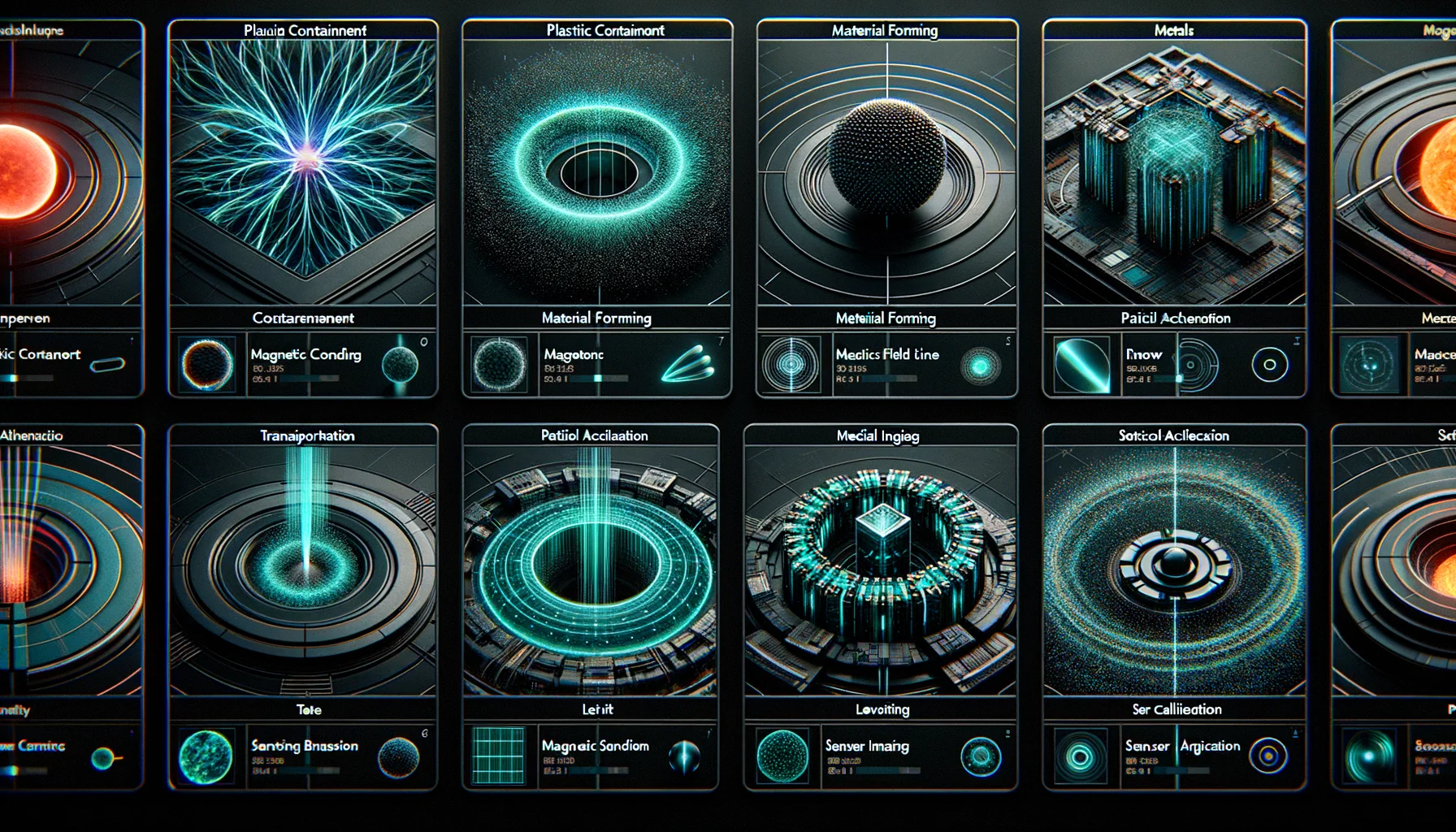
Highfield Magnetics supplies the field — the literal magnetic field — that enables six other partner companies to function at their design specifications. Without extreme-field superconducting technology, the fusion reactor cannot confine its plasma, the antimatter trap cannot hold its positrons, the subterranean railway cannot levitate its pods. The field is infrastructure. Each relationship below is typed: Highfield enables downstream divisions with magnetic field systems, and requires upstream materials and manufacturing from Metallic Sciences (MS-19 substrate tape) and Phase Flash (cryogenic cooling).
STELLAR FURNACE
MIF Compression Coils for Fusion Plasma Confinement
Stellar Furnace's magnetized inertial fusion (MIF) approach requires rapid magnetic compression of a preheated magnetized plasma target. The compression coil set — Iron Horse pulsed magnets firing in programmed sequence — would squeeze the plasma from a 10 cm diameter target to a smaller hot spot in under 10 milliseconds. Target peak field at compression: 100 Tesla (the CHRONOS-100 development goal). The timing precision required is ±50 microseconds across all coils simultaneously. Highfield is developing both the coil hardware and the firing control system for this application.
ANTIMATTER PRODUCTION
Penning Trap Array Magnets for Positron Storage
Antimatter Production's Halo Accelerator uses a multi-well Penning trap array to store positrons at densities required for the annihilation fuel cycle. A Penning trap confines charged particles using a combination of static electric and magnetic fields — the magnetic field provides radial confinement, the electric field provides axial confinement. The magnetic field must be continuous (no interruptions that would allow particle loss), uniform to better than 10 ppm across the trap volume, and stable for the duration of a storage cycle measured in hours. Highfield supplies ISO-1-derived persistent-mode solenoids for each Penning trap well. The multi-well array requires field interpolation between adjacent traps — a shimming challenge Highfield's active correction coil technology addresses directly. Long-term antimatter storage density requirements are one of the research motivations for exploring field strengths beyond the current CRYO-10 tier.
LORENTZ AEROSPACE
MHD Propulsion Field Coils for Seawater Drives
Lorentz Aerospace's MHD seawater thruster operates by driving seawater (an ionic conductor) through a crossed electric and magnetic field — the Lorentz force accelerates the conducting fluid, generating thrust without moving parts. The magnetic field component is provided by Highfield CRYO-10 arrays: persistent-mode, cryocooler-cooled, generating 10 Tesla across the thruster channel geometry. MHD seawater propulsion at 10 Tesla produces measurable thrust, though efficiency remains a research challenge due to seawater's relatively low electrical conductivity compared to liquid metals. The CRYO-10 thruster package is designed to ship as a sealed, self-contained unit — cryocoolers, power conditioning, and monitoring electronics integrated — requiring no cryogenic expertise from the vessel operator.
METALLIC SCIENCES
MS-19 Substrate Tape + Levitation Foundry Co-Location
The Metallic Sciences relationship is bidirectional. Metallic Sciences supplies the MS-19 tungsten-rhenium substrate tape that Highfield's REBCO deposition process requires. Highfield supplies the magnetic field systems that Metallic Sciences uses for electromagnetic forming research — contactless shaping of metals using high-field magnetic pressure. The co-location of the REBCO deposition line and the MS-19 rolling mill allows substrate to enter the deposition process within 45 minutes of final rolling, before surface oxide layers can form. This integration reduces the surface contamination that can degrade REBCO film quality in supply-chain-dependent production.
FERMAT LOGISTICS
Subterranean Maglev Rail System Magnets
Fermat Logistics operates the subterranean logistics infrastructure — freight routing through the Velocity Grid's underground corridors. The maglev rail system that carries freight pods through these corridors uses Highfield CRYO-10 arrays in a Halbach configuration for levitation and linear synchronous motor stators for propulsion. The underground environment presents specific engineering constraints: limited maintenance access, high humidity, and the requirement for persistent-mode (zero power draw) operation during transit — a cargo pod levitating between stations cannot rely on powered coils that could quench mid-run. Highfield's persistent-mode CRYO-10 units, with sub-0.1 ppm/hour field drift and full protection against quench-induced training, meet Fermat's operational uptime requirements. The Velocity Grid's underground maglev installation represents the largest deployed fleet of Highfield CRYO-10 units outside of fusion and aerospace applications.
HIGHFIELD MAGNETICS INTEGRATION
→ STELLAR FURNACE — High-field pulsed magnets for plasma compression in fusion research.
→ METALLIC SCIENCES — MS-Alloy 808 track conductors, Aerogel-Titanium pod chassis, Mu-Metal cabin shielding. Mag-Forge feedstock.
→ FERMAT LOGISTICS — H-LEV is the physical "Flash Sled" in the Fermat multi-modal network. Sensitivity-class routing for the pod fleet.
→ MAXWELL CONTINUUM — NeuroRail sensor grid (Fiber Bragg Gratings every 10m), LIDAR interferometry, Active Noise Cancellation.
→ VAPOR VACUUM — Evacuated tube infrastructure for vacuum transport sectors.
→ FOUNDATION KINETICS — Flux-Bearing mag-lev joints, magnetic levitation arrays for the Lights-Out Floor.
→ LORENTZ AEROSPACE — CRYO-10 arrays for MHD propulsion field generation.