The Linear Bow
LUNAR MASS DRIVER
ELECTROMAGNETIC LAUNCH INFRASTRUCTURE FOR LUNAR EXPORT ECONOMY
The Linear Bow is a 20-kilometre superconducting linear electromagnetic accelerator laid flat on the lunar surface. It accelerates cargo sleds to 2.38 km/s — lunar escape velocity — and releases them on ballistic trajectories to orbital capture facilities at Earth-Moon Lagrange points or low Earth orbit. There is no propellant. There is no combustion. There are no moving parts in the launch mechanism. A superconducting coil array converts reactor electricity into kinetic energy, and the payload leaves the Moon.
The concept was first proposed by Gerard K. O'Neill at Princeton University in 1974. O'Neill recognised that the Moon's low gravity (1.62 m/s²), lack of atmosphere, and abundance of useful raw materials made it the ideal source for construction mass in space — but only if that mass could be launched cheaply. Chemical rockets were prohibitively expensive per kilogram launched. An electromagnetic catapult, powered by solar energy, could launch material at marginal cost approaching zero once the infrastructure was built. O'Neill's original design specified a linear synchronous motor accelerating 10 kg payloads at 30 g over a 10 km track. The physics was straightforward. The engineering, in 1974, was not — the superconductor performance, the power systems, and the precision guidance required did not exist. They exist now.
The Accelerator
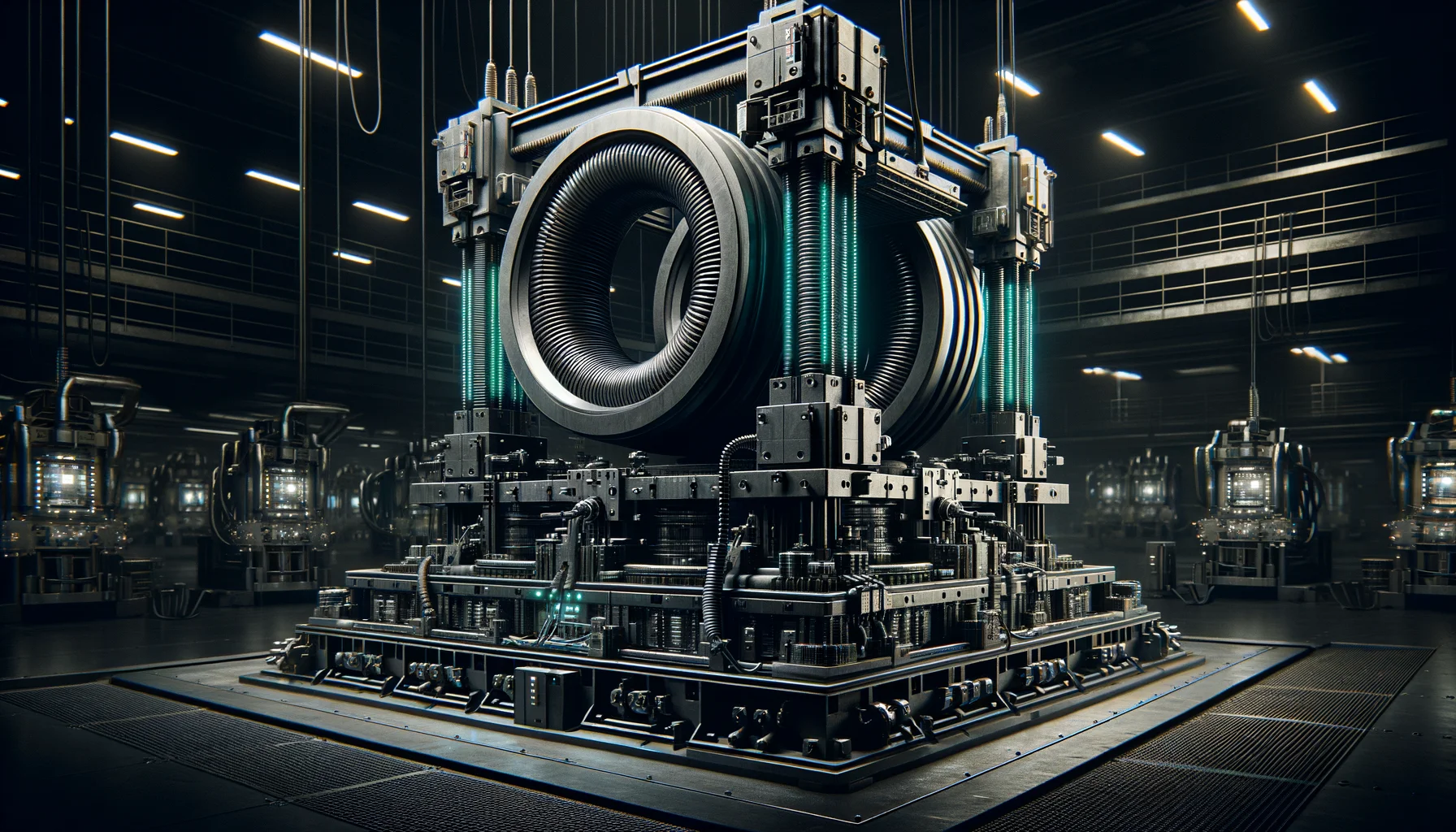
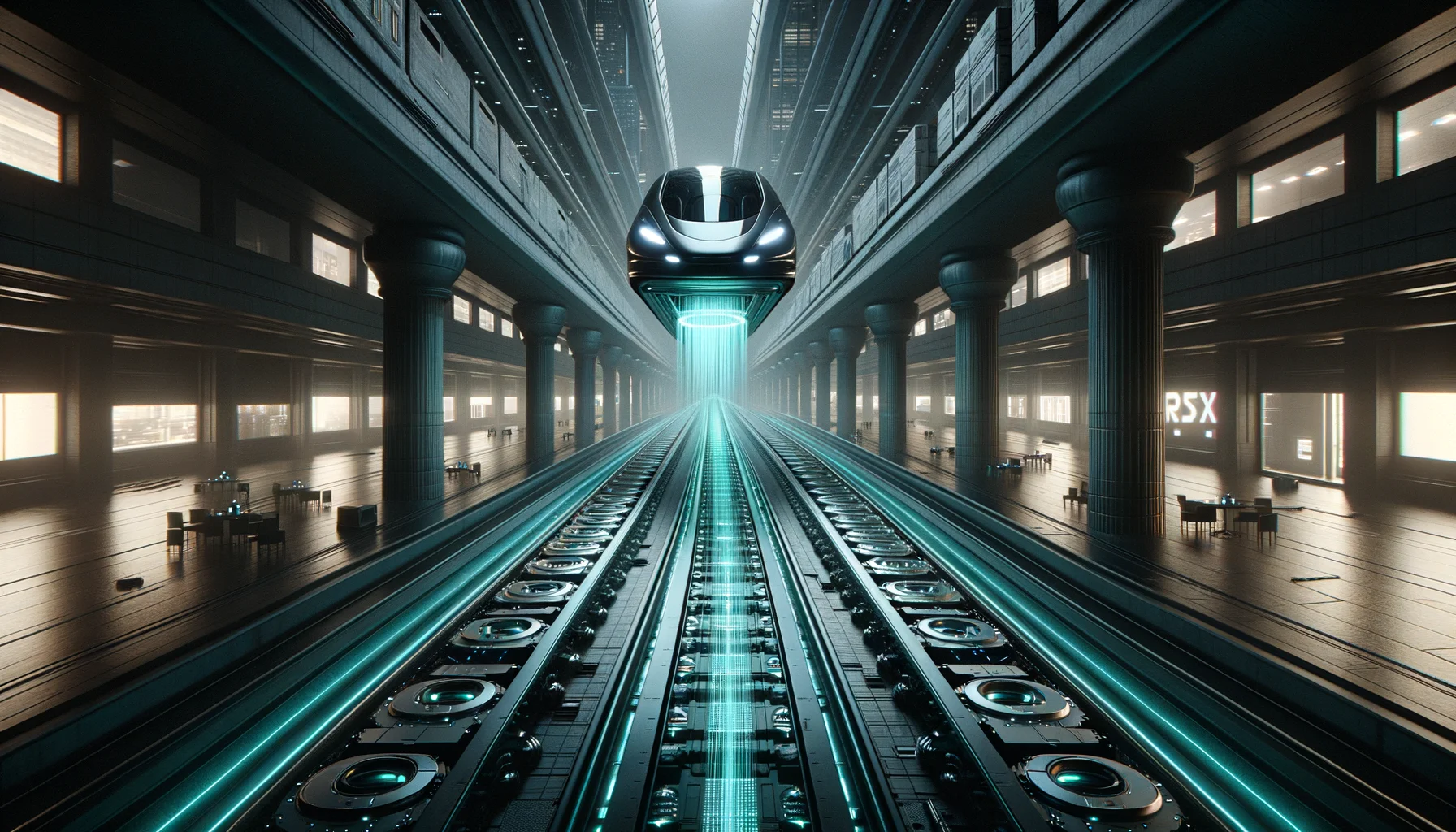
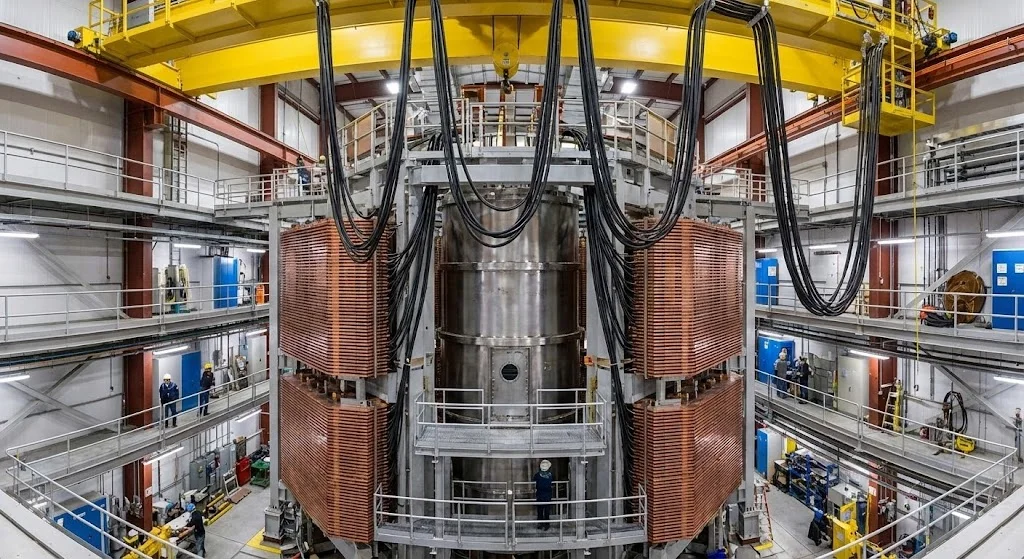
The Linear Bow is a linear synchronous motor at continental scale. The track consists of a sequence of drive coils — superconducting solenoids wound from Highfield Magnetics REBCO tape on Metallic Sciences structural mandrels — embedded in a sintered-regolith foundation prepared by Foundation Kinetics robotic construction teams. The drive coils are energised in precise sequence as the payload sled passes through them, generating a traveling magnetic field that accelerates the sled via the same linear synchronous motor principle used in the H-LEV and Geo-Core transit systems. The sled carries no engine. It carries superconducting field coils that interact with the drive field — the sled is a passive armature propelled by the track infrastructure.
The acceleration profile is constrained by the payload. Bulk cargo — regolith, refined metals, helium-3 canisters — tolerates hundreds of g. At 100 g average acceleration, the sled reaches escape velocity in approximately 2.9 seconds over a track length of 3.4 km. The remaining 16.6 km of track provides margin for lower-acceleration profiles (sensitive cargo, precision instruments) and for the regenerative deceleration of the sled cradle after payload release. A 10 g profile — which permits launch of electronics, biological samples, and pre-assembled structural components — requires the full 20 km track and approximately 24 seconds of acceleration.
The track is not straight. The lunar surface is curved, and the launch trajectory must account for the Moon's rotation (4.6 m/s at the equator, negligible but non-zero). The track follows a shallow catenary aligned with the desired launch azimuth, with the exit ramp angled to inject the payload onto the correct ballistic arc. The exit velocity vector must be accurate to within 0.01° to hit the capture window at the destination — an angular precision of approximately 0.2 milliradians over a 2.38 km/s release. This is achieved by the timing precision of the drive coil energisation sequence: the Maxwell Continuum waveform controller fires each coil with sub-microsecond timing, and the final coil group performs fine velocity trimming — adding or subtracting metres per second — to correct for any accumulated trajectory error.
The Sled
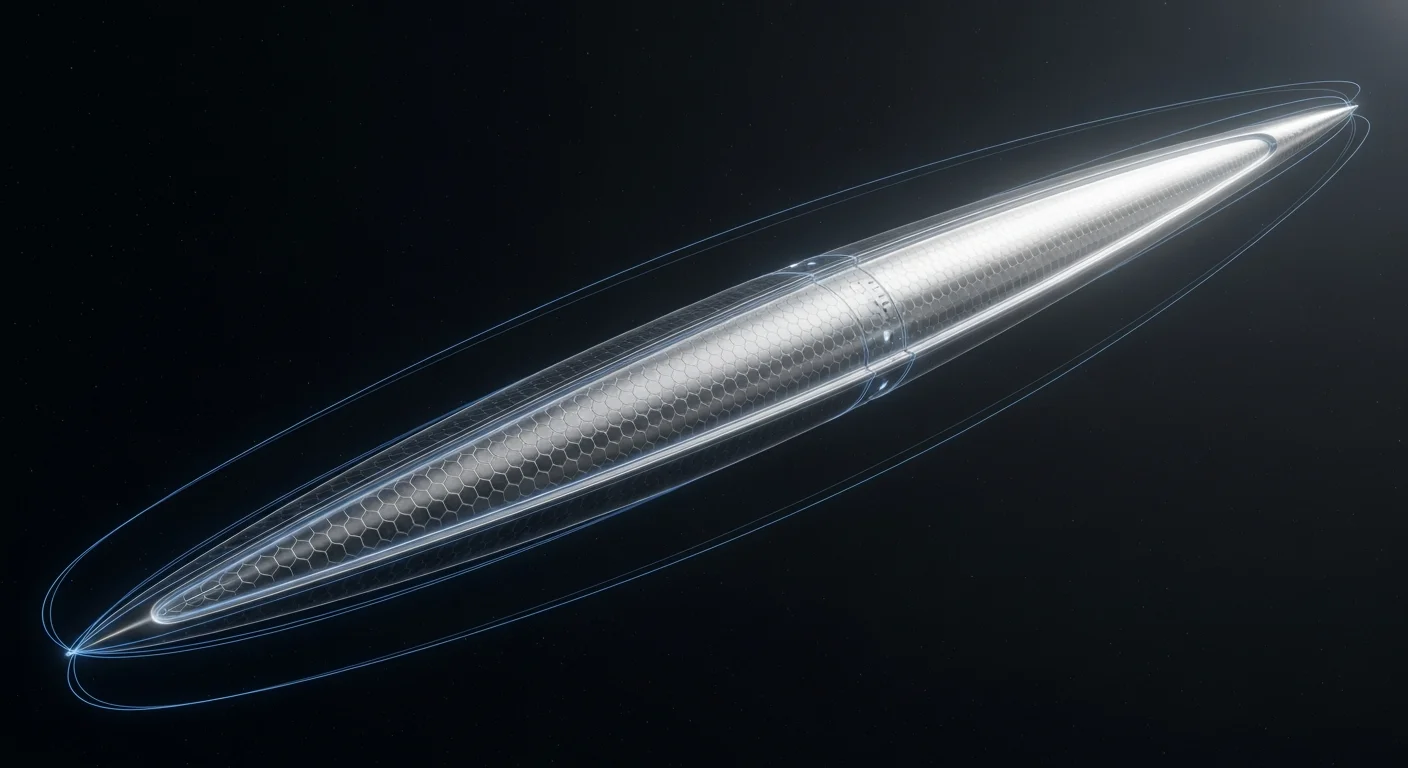
The payload sled is a reusable Metallic Sciences titanium-aluminium cradle carrying Highfield Magnetics CRYO-10 superconducting field coil arrays. The field coils are persistent-mode — once charged, they maintain their field indefinitely without power input, which is critical because the sled has no power connection to the track during the acceleration phase. The sled levitates on the same Halbach-array electrodynamic suspension used in H-LEV: at launch velocities, the levitation gap is stable and self-correcting without active control.
At the end of the acceleration phase, the sled reaches the release point. Payload separation is mechanical: pyrotechnic bolts release the cargo container, which continues on the ballistic trajectory at escape velocity. The sled, now empty, enters the deceleration section of the track — a reverse-energised coil array that brakes the sled electromagnetically, recovering approximately 85% of the sled's kinetic energy back into the power grid through regenerative braking. The sled decelerates to a stop, is returned to the loading station by a low-speed return track, recharged, reloaded, and launched again. Cycle time from launch to next launch: under 15 minutes for bulk cargo, longer for precision payloads requiring careful alignment.
The Power System
Launching a 1,000 kg payload to 2.38 km/s requires approximately 2.83 gigajoules of kinetic energy. At 85% regenerative recovery from the sled deceleration, the net energy per launch is approximately 425 megajoules — the kinetic energy of the payload alone, which departs and is not recovered. At one launch per 15 minutes (4 per hour), the sustained power draw is approximately 28 megawatts. At one launch per 5 minutes (12 per hour, high-throughput bulk operations), the sustained draw is approximately 85 megawatts.
The primary power source is a Stellar Furnace compact fission reactor at the midpoint of the track, providing continuous electrical power to a capacitor bank array distributed along the track's length. The capacitor banks charge continuously between launches and discharge into the drive coils during the acceleration phase — the same pulsed-power architecture used in the CHRONOS-100 platform, scaled to multi-gigajoule energy storage. Supplementary solar power from photovoltaic arrays along the track provides baseline power during the 14-day lunar day. During the 14-day lunar night, the reactor provides all power. The system operates at full launch rate regardless of solar availability.
On the lunar surface, where solar flux is 1,361 W/m² with no atmospheric attenuation and no weather, a 1 km² solar array produces approximately 136 megawatts peak — more than sufficient for high-throughput launch operations during the day, with excess power charging the capacitor banks and electrolyser systems. The Stellar Furnace reactor is sized for night operations and serves as the uninterruptible baseline. This dual-source architecture ensures the mass driver operates continuously through the full lunar day-night cycle.
The Catch
A payload launched at 2.38 km/s from the lunar surface arrives at its destination on a ballistic trajectory with residual velocity that must be matched for capture. The destination determines the capture architecture.
Earth-Moon L2. The Modular Habitats Anchor station at the Earth-Moon L2 Lagrange point serves as the primary receiving facility. Payloads arrive at L2 with modest residual velocity (tens of m/s relative to the station after the ballistic coast). Capture is performed by a Highfield Magnetics electromagnetic decelerator — essentially a small-scale reverse Linear Bow — that brakes the incoming payload and deposits it into the station's cargo handling system. The decelerator recovers the payload's kinetic energy regeneratively, feeding it into the station's power grid.
Low Earth Orbit. Payloads destined for LEO require a trajectory that intersects Earth's gravitational sphere of influence. An onboard solid-rocket kick motor — supplied by Lorentz Aerospace — provides the delta-v correction for LEO insertion and circularisation. The kick motor is the only chemical propulsion element in the entire system, and it is small: the Linear Bow provides 95%+ of the total delta-v electromagnetically.
Direct surface delivery. For payloads destined for Earth's surface (rare materials, helium-3 canisters), an aeroshell and parachute recovery system designed by Lorentz Aerospace provides atmospheric entry and landing. The mass driver provides the departure energy; atmospheric drag provides the arrival braking. No powered descent is required.
The Cargo
The Selene lunar colony exists to export. The mass driver is the export infrastructure. The primary cargo streams are:
Helium-3. Lunar regolith contains helium-3 implanted by four billion years of unshielded solar wind. Foundation Kinetics harvester rovers heat regolith to 600°C, volatilising the He-3 for capture and compression into standard canisters. Helium-3 is among the most energy-dense aneutronic fusion fuels known — a single canister represents fuel for months of Stellar Furnace reactor operation. The mass driver launches He-3 canisters to the Anchor station for transfer to Earth orbit. This is the revenue-generating cargo stream that justifies the entire Selene infrastructure investment.
Refined metals. Lunar regolith is approximately 20% silicon, 12% iron, 8% aluminium, 6% magnesium, and 5% titanium by mass, with trace quantities of chromium, manganese, and other industrial metals. Metallic Sciences operates reduction furnaces at the Selene Refinery, producing refined metals for in-space construction. Launching refined aluminium, titanium, and iron to L2 or LEO is dramatically cheaper than launching the same mass from Earth's surface (lunar escape velocity is 2.38 km/s vs. Earth's 11.2 km/s, and there is no atmosphere to punch through). The mass driver makes the Moon the lowest-cost source of structural metals for orbital construction.
Regolith aggregate. For large-scale orbital construction projects (radiation shielding mass, bulk fill, sintered structural panels), raw or minimally processed regolith launched in bulk containers provides construction mass at the lowest possible cost per kilogram. The mass driver makes bulk regolith export economically viable because the marginal launch cost — electricity — approaches zero with solar power on the lunar surface.
Specifications
| LINEAR BOW — LUNAR MASS DRIVER SPECIFICATIONS | |
|---|---|
| TRACK LENGTH | 20 km |
| EXIT VELOCITY | 2.38 km/s (lunar escape velocity) |
| ACCELERATION (BULK CARGO) | 100 g average over 3.4 km |
| ACCELERATION (SENSITIVE CARGO) | 10 g average over 20 km |
| PAYLOAD MASS | 100 kg – 10,000 kg (modular sled sizing) |
| LAUNCH RATE (BULK) | 12 per hour (5-minute cycle) |
| LAUNCH RATE (PRECISION) | 4 per hour (15-minute cycle) |
| ANNUAL THROUGHPUT (BULK) | ~100,000 tonnes at 12/hr, 1,000 kg avg, continuous ops |
| DRIVE COILS | Highfield Magnetics REBCO on Metallic Sciences mandrels |
| SLED FIELD COILS | CRYO-10 persistent-mode Halbach array |
| SLED LEVITATION | Electrodynamic suspension (Halbach EDS), passive, no active control |
| SLED RECOVERY | Electromagnetic regenerative braking, 85% energy recovery |
| VELOCITY PRECISION | ±0.5 m/s at release (0.02% of exit velocity) |
| ANGULAR PRECISION | ±0.2 mrad at release |
| TIMING CONTROL | Maxwell Continuum sub-microsecond coil sequencing |
| ENERGY PER LAUNCH (1,000 kg) | 2.83 GJ gross / 425 MJ net (after regen) |
| POWER SOURCE | Stellar Furnace fission reactor (85 MWe) + solar array (136 MW peak/km²) |
| ENERGY STORAGE | Distributed capacitor banks, CHRONOS-100 pulsed-power architecture |
| TRACK FOUNDATION | Sintered regolith, Foundation Kinetics robotic preparation |
| CAPTURE (L2) | Electromagnetic decelerator at Modular Habitats Anchor station |
| CAPTURE (LEO) | Solid-rocket kick motor (Lorentz Aerospace) for circularisation |
| PRIMARY CARGO | He-3 canisters, refined metals, bulk regolith |
| SCHEDULING | Fermat Logistics orbital mechanics + manifest optimisation |
| HERITAGE | O'Neill (1974), NASA electromagnetic launch studies (1980s–present) |
Division Integration
Highfield Magnetics — the accelerator. Drive coils, sled field coils, electromagnetic decelerator at the capture end. Every superconducting element in the system is a Highfield deliverable. This is the division's largest single product by physical scale.
Stellar Furnace — power. The fission reactor that runs the mass driver through the lunar night and provides baseline power continuously. Sized at 85 MWe for high-throughput operations.
Maxwell Continuum — timing and waveform control. The drive coil sequencing system that achieves sub-microsecond timing precision across 20 km of coils. The same Parabolic Sine waveform architecture used in the Geo-Core transit network, applied to a system that releases payloads at escape velocity instead of stopping them at a station.
Metallic Sciences — structural mandrels for the drive coils, the titanium-aluminium sled cradle, and the reduction furnaces at Selene that produce the refined metals the mass driver exports.
Foundation Kinetics — robotic construction of the 20 km track foundation from sintered regolith, plus the harvester rovers that collect He-3 for export.
Modular Habitats — the Selene colony infrastructure that the mass driver serves, and the Anchor station at L2 that receives the payloads.
Lorentz Aerospace — kick motors for LEO-bound payloads, aeroshell recovery systems for Earth-surface delivery, and transfer vehicles shuttling crew and cargo between Anchor, Waypoint, and Selene.
Fermat Logistics — launch scheduling, orbital mechanics computation for each trajectory, cargo manifest optimisation, and coordination between the mass driver launch cycle and the capture facility reception schedule.
Aetheric Sciences — trajectory computation and real-time guidance correction. The digital twin models the payload's ballistic arc from release to capture, providing the velocity and angular corrections that the final drive coils apply before release.
The Economics
The cost of launching mass from the Moon is dominated by the amortised capital cost of the mass driver infrastructure — the track, the reactor, the solar arrays, the sled fleet, and the capture facility. The marginal cost per launch is the electricity consumed, which on the lunar surface with solar power approaches zero. At an annual throughput of 100,000 tonnes and an infrastructure amortisation period of 20 years, the cost per kilogram launched from the Moon is projected to be two to three orders of magnitude below the cost per kilogram launched from Earth's surface by any chemical rocket. This cost advantage is what makes the Selene export economy viable and what justifies the mass driver as the single largest capital investment in the lunar programme.
O'Neill understood this in 1974. The physics has not changed. The superconductors have.