Highfield Magnetics
ADVANCED FIELD ENGINEERING & CONFINEMENT
HIGHFIELD MAGNETICS // LAKS INDUSTRIES
"Structure is defined by the Field."
Quantum computing, fusion energy, and antimatter containment all share a single point of failure: The Magnetic Field. If the field wavers, the qubit decoheres. If the field breaks, the reactor melts. We are not building "stronger magnets." We are solving the specific physics problem that limits each tier.
01 // THE GOD STATS: FOUR TIERS OF IMPOSSIBILITY
| PRODUCT | FIELD | THE "GOD STAT" | APPLICATION |
|---|---|---|---|
| ISO-1 | 1 T | Perfect Uniformity (0.001 ppb) | Quantum Computing, Crystal Growth |
| CRYO-10 | 10 T | Portability (Air Cooled) | Medical, Propulsion, Industrial |
| CHRONOS-100 | 100 T | Continuous Time (Steady State) | Fusion Energy, Compact Reactors |
| MEGA-1K | 1000 T | Macro Volume (1 km diameter) | Planetary Defense, Arcology Shields |
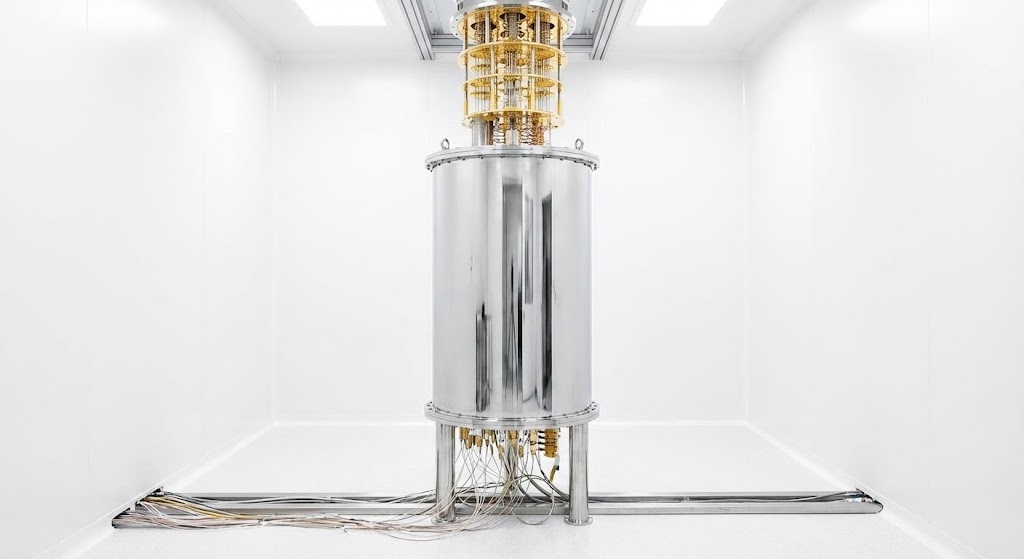
FIG 1.0: ISO-1 "NULL CORE" — PERFECT SPHERE, 0.001 PPB HOMOGENEITY
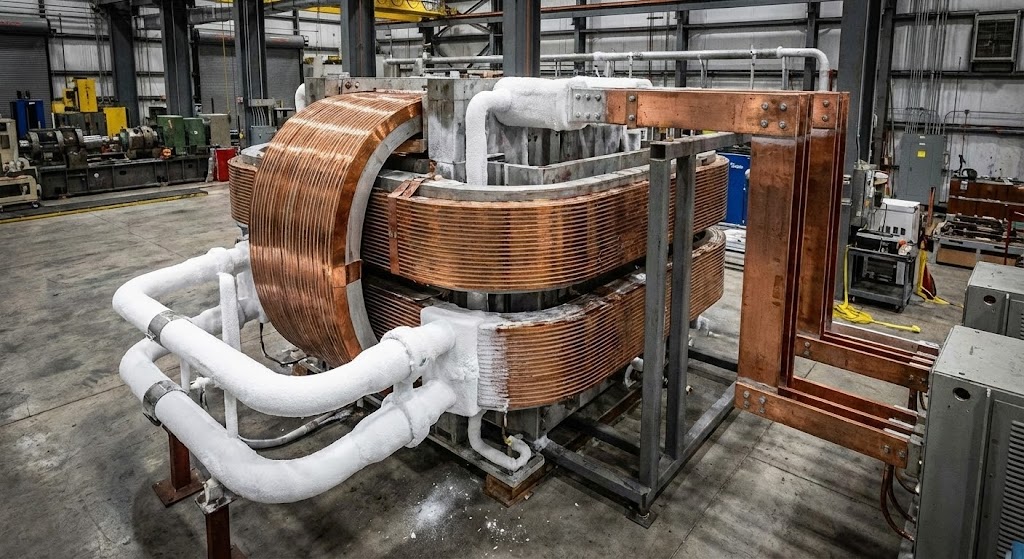
FIG 2.0: CRYO-10 "ROVER BLOCK" — 10T IN A PELICAN CASE
02 // THE ENGINEERING: FROM ATOMS TO ARCHITECTURE
ISO-1 "NULL CORE" (1T)
The Perfect Sphere — Active Flux Erasure
A floating sphere of polished Silicon-Carbide, 1 meter diameter. No visible wires. A Halbach sphere arrangement eliminates edge effects. Layer 1: Superconducting Meissner Shield expels all external fields. Layer 2: 3D-Printed Conductor Lattice driven by a neural network—senses the field 1,000,000 times per second and injects anti-noise micro-currents. Result: room-temperature quantum memory stability.
CRYO-10 "ROVER BLOCK" (10T)
The Ruggedized Brick — No-Insulation REBCO
A matte-black anodized aluminum block with fractal cooling fins. Size of a Pelican case. REBCO tape wound bare, turn-to-turn—no insulation. Heat spreads instantly across the coil instead of creating hot spots. Diamond Heat Spreaders linked to a solid-state Stirling Cryocooler. You plug it into a wall outlet. A 10T field you can throw in the back of a truck.
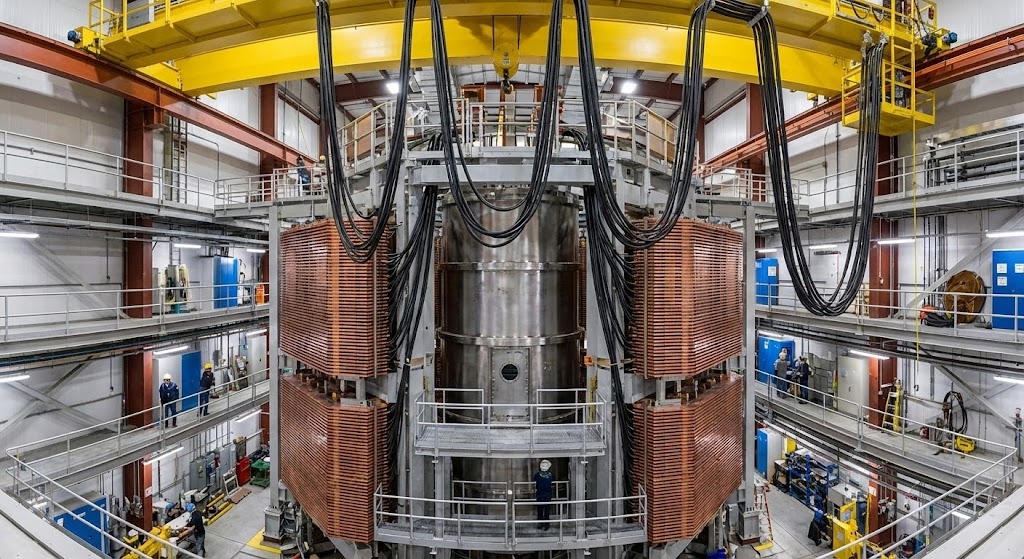
FIG 3.0: CHRONOS-100 "ETERNAL RING" — 100T CONTINUOUS FIELD
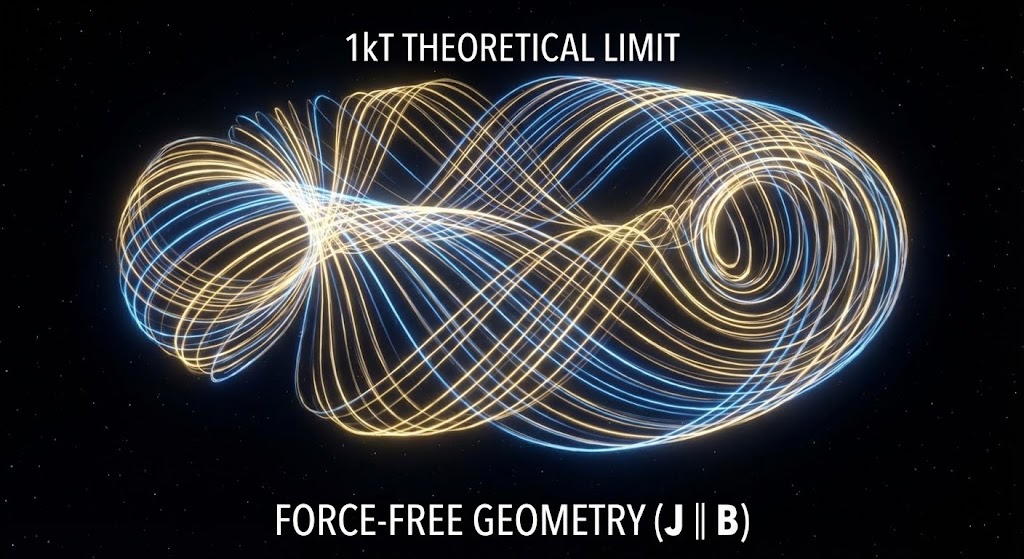
FIG 4.0: MEGA-1K "SKY SHIELD" — FORCE-FREE PYLON CONSTELLATION
CHRONOS-100 "ETERNAL RING" (100T)
The Compression Torus — Zylon Overwrap + Vortex Pinning
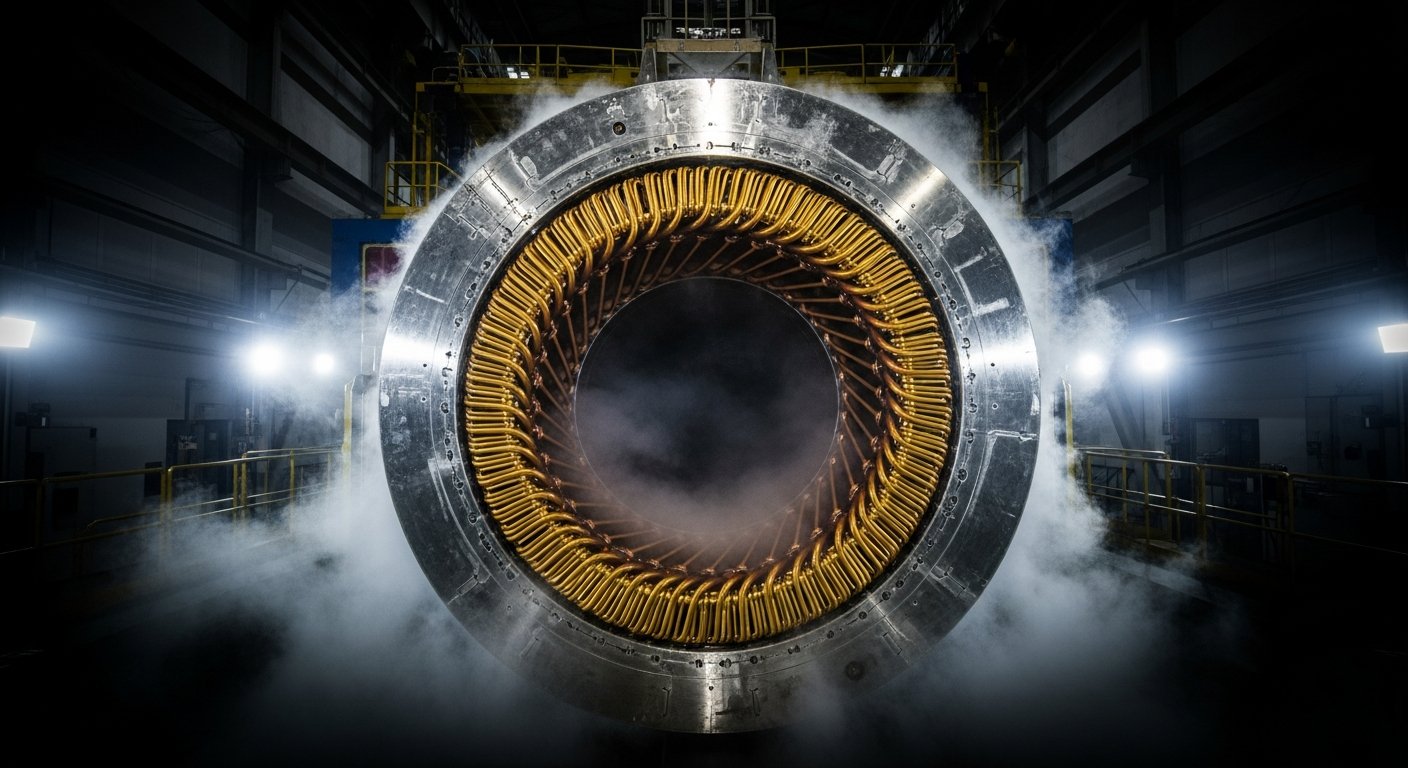
A 3-meter horizontal ring with titanium bracing. The center bore glows Cherenkov blue from air ionization. At 100T, magnetic pressure hits 4 GPa—copper melts, steel stretches. HTS tape co-wound with Zylon fiber (stronger than Kevlar). Nano-defects in the superconductor "pin" magnetic vortices in place, preventing resistance. Holds 100T indefinitely. Enables compact fusion (Stellar Furnace).
MEGA-1K "SKY SHIELD" (1000T)
The Force-Free Lattice — Beltrami Fields
Not a single object. A constellation of 100-meter Pylons in a hexagonal grid. At 1000T, magnetic pressure is 400,000 atmospheres. No material can hold that mechanically. The solution: Force-Free Topology. Current (J) flows parallel to the field lines (B). When J ∥ B, the Lorentz Force drops to zero. Coils wound in twisted helical patterns (Beltrami fields). A planetary shield that doesn't rip itself apart because the forces cancel themselves out.
03 // PROJECT H-LEV: FLIGHT AT ZERO ALTITUDE
We do not view this as a "train." We view this as a Constrained Aircraft. The H-LEV is a passive-stability / active-propulsion hybrid using HTS and advanced composites.
The Track: "Dual-C" Channel. Two C-shaped guide rails face each other. The Pod sits inside, captured by geometry—it cannot derail. Track conductor: Laks-Alloy 808 (Metallic Sciences)—Nano-Carbon Copper Matrix, 40% lighter than copper, 150% more conductive, tensile strength rivaling steel. Embedded in Sintered Basalt Geopolymer.
The Levitation Engine: CRYO-10 Array. REBCO tape stacks in a Halbach "Screamer" Array (↑ → ↓ ← ↑)—cancels field inside (protecting passengers), doubles field outside (5T lifting force). At 30 km/h, repulsive force exceeds pod weight. Wheels retract. The pod flies.
The Propulsion: Linear Synchronous Motor. The pod surfs a traveling magnetic wave. Speed is mathematically locked to grid frequency—0% slip. Regen braking recovers 85% of energy, silent and contactless.
Zero-Ripple Motion Profile. Fifth-Order Polynomial trajectory. Jerk capped at 0.2 m/s³ (below human vestibular threshold). You don't feel a "push"—gravity gently shifts. Gyroscopic seats on 2-axis gimbals cancel the acceleration vector. Your coffee never ripples.
Vacuum Compatibility. In atmosphere: Mach 0.8. In Velocity Grid vacuum sectors: Mach 3+. Radiative "Vantablack" Graphene underbelly dumps heat as infrared. Phase-Change Heat Sinks store cabin heat for station discharge. All materials Low-Outgassing (spacecraft-grade).
04 // THE FLASH: ORBITAL SURFACE VEHICLE
FIG 5.0: FLASH VEHICLE — HYPER-OGIVE NEEDLE, 100m x 3m
Three speed classes. Same track. Same physics. Different constraints.
MACH 12 — "THE GENTLEMAN'S HYPERSONIC"
14,800 km/h — The Comfort Standard
At Mach 12 you feel 0.7G—30% lighter than normal. No rotation, no floating, laptop stays on the tray table. You feel athletic and spry. NY → London: 35 minutes. LA → Tokyo: 55 minutes. Extreme velocity with total dignity.
MACH 23 — "THE ZERO-G CRUISER"
28,400 km/h — Orbital Velocity at Sea Level
Centrifugal force equals gravity. Passengers float. Coffee drifts in spheres. 30-minute space walk between acceleration and braking phases. The pod surfs a Standing Wave RF Cavity (1.2 GW from one Stellar Furnace reactor). Chassis: 100m Hyper-Ogive Needle in Beryllium-Graphene Lattice. NY → London: 21 minutes.
MACH 50 — "THE OVERDRIVE"
61,250 km/h — Inverted High-G Express
At Mach 50, centrifugal force exceeds gravity by 3.7G. The cabin rotates 180°—passengers ride inverted. Earth above your head, space below your feet. The maglev system flips polarity: tethering the pod to the track with 4,000 tons of force. Track anchors driven 50m into bedrock. LA → Tokyo: 17 minutes. London → Sydney: 28 minutes. For cargo and "Express Class" only.
| ROUTE | DISTANCE | AIRLINE | MACH 12 | MACH 23 | MACH 50 |
|---|---|---|---|---|---|
| NY → London | 5,500 km | 7 hr | 35 min | 21 min | 11 min |
| LA → Tokyo | 8,800 km | 11 hr | 55 min | 34 min | 17 min |
| London → Sydney | 17,000 km | 21 hr | 1 hr 48 min | 55 min | 28 min |
05 // THE FORCE LAYER: THE INVISIBLE HAND
We treat magnetic fields as solid objects. We use them to hammer, squeeze, and throw matter without ever touching it.
THE MAG-FORGE (Contactless Manufacturing). Molten Laks-Alloy injected into a vacuum chamber, surrounded by CHRONOS-100 coils. 100T pulse at 4 GPa crushes all porosity out of the metal. The "mold" is software—shape the field, shape the metal. Geometries impossible to release from a physical mold. Integration: Metallic Sciences.
THE LINEAR BOW (Mass Driver). A 5km vertical shaft using H-LEV stator tech. Payload experiences 100G of acceleration (cargo only). Exit velocity: Mach 25—punches through atmosphere into Low Earth Orbit without burning a drop of fuel. Defensive mode: point it sideways, it's a railgun. MEGA-1K blocks incoming fire; the Linear Bow returns tungsten rods at 8,000 m/s. Integration: Lorentz Aerospace, Antimatter Production.
THE FLUX-GRIP (Tractor Beam). Six ISO-1 coils in a cube configuration create a movable "Null Point" via intersecting field traps. The Invisible Forklift: lifts cargo via magnetic tether. The Hazmat Hand: handles radioactive cores and bio-hazard vials without contact. Integration: Aetheric Sciences, Stellar Furnace.
- [REF-01] 45.5-Tesla Direct-Current Magnetic Field Generation. Hahn, S., et al. Nature 570. (2019). [No-Insulation HTS Basis].
- [REF-02] Force-Free Magnetic Fields: The Beltrami Topology. Lust, R., Schluter, A. Zeitschrift für Astrophysik. (1954). [MEGA-1K Physics].
- [REF-03] On Gauge Invariance and Vacuum Polarization. Schwinger, J. Physical Review 82. (1951). [1MT / Vacuum Breakdown Limits].
- [REF-04] Electrodynamic Suspension via Flux Pinning in Type-II Superconductors. Applied Superconductivity. (2020). [H-LEV Quantum Locking].
- [REF-05] Halbach Array Optimization for Maglev Propulsion Systems. IEEE Trans. Magnetics. (2022). [The "Screamer" Configuration].
- [REF-06] Fifth-Order Motion Profiles for Jerk-Limited Trajectory Generation. Mechatronics. (2021). [Zero-Ripple Standard].
- [REF-07] Standing Wave RF Acceleration of Macroscopic Payloads. Laks Internal Research Review. (Restricted). [Flash Propulsion].
- [REF-08] Contactless Magnetic Pressure Forming at Multi-GPa Regimes. Journal of Materials Processing. (2023). [Mag-Forge Specification].
LAKS INDUSTRIES INTEGRATION
→ STELLAR FURNACE — CHRONOS-100 enables compact fusion confinement. The Flash draws 1.2 GW from Stellar reactors.
→ METALLIC SCIENCES — Laks-Alloy 808 track conductors, Aerogel-Titanium pod chassis, Mu-Metal cabin shielding. Mag-Forge feedstock.
→ FERMAT LOGISTICS — H-LEV is the physical "Flash Sled" in the Fermat multi-modal network. Sensitivity-class routing for the pod fleet.
→ MAXWELL CONTINUUM — NeuroRail sensor grid (Fiber Bragg Gratings every 10m), LIDAR interferometry, Active Noise Cancellation.
→ VAPOR VACUUM — Evacuated tube infrastructure for Velocity Grid sectors. Mach 3+ in vacuum mode.
→ FOUNDATION KINETICS — Flux-Bearing mag-lev joints, gravity plating for the Lights-Out Floor.
→ LORENTZ AEROSPACE — Linear Bow launches payloads to LEO. CRYO-10 arrays in spacecraft propulsion.
GRAVITATIONAL EFFECTS OF ELECTROMAGNETIC ENERGY DENSITY: THE 100T MEASUREMENT OPPORTUNITY
Electromagnetic energy curves spacetime. The effect is vanishingly small at achievable field strengths, but it is real, measurable, and within our technical reach at 100 Tesla.
The coupling between electromagnetic energy density and gravitational acceleration follows directly from general relativity. The stress-energy tensor couples to spacetime curvature through the constant 8πG/c⁴, approximately 2×10⁻⁴³ in SI units. Spacetime is stiff. At 1000 Tesla over a one-meter length scale, the induced gravitational acceleration is roughly 10⁻¹⁴ m/s². This is not large. Modern atom interferometry achieves sensitivities of 10⁻¹⁵ g. The measurement window exists. We can detect the gravitational signature of the field itself.
This is not a theoretical curiosity. Direct measurement of EM energy gravitating would be the first experimental confirmation of the Einstein field equations in the electromagnetic regime. Every precision test of relativity to date has relied on massive bodies—neutron stars, planetary orbits, atomic clocks. None has isolated the gravitational effect of pure electromagnetic energy. The measurement is doable because we have the tools: sustained superconducting fields at 100 Tesla, quantum sensors at the required sensitivity, and the physics fully worked out.
Our 100 Tesla roadmap positions us to execute this measurement. The path forward is clear. REBCO tape optimization extends critical field performance. Hybrid magnet configurations stack resistive and superconducting coils. Active quench protection ensures repeatability. At 100 Tesla sustained, we acquire the data density needed for a gravitational detection attempt. An atom interferometer stationed near the magnet bore detects phase shifts proportional to the local gravitational acceleration. The signal integrates over measurement time. At our proposed field strength and geometry, a 24-hour run yields sufficient counts to resolve effects at the 10⁻¹⁴ g level.
The medium-term milestone is 1000 Tesla. Flux compression technology, mature in pulsed systems, becomes applicable to semi-stable platforms through force-free conductor geometries and improved survival margins. At 1000 Tesla, gravitational effects strengthen by two orders of magnitude. Detection confidence increases sharply. The physics scales predictably: B² increases energy density, gravitational coupling is linear in energy density, sensitivity compounds.
Beyond pure field strength lies resonant amplification. High-Q electromagnetic systems—cavity resonators, plasma confinement geometries, non-neutral plasma traps—can concentrate field energy far beyond what brute-force generation alone achieves. A 1.5 Tesla input field, resonantly amplified through a quality factor of 10⁶, produces an effective field strength equivalent to 10,000 Tesla in gravitational coupling. An MRI-class magnet becomes the prime mover. The amplification system does the heavy lifting. This approach breaks the brute-force scaling wall. Engineering leverage replaces raw power.
Parallel to sustained-field development, dense plasma focus technology offers an alternative path. Current DPF configurations achieve 1000 to 10,000 Tesla in pinch geometry—magnetar-level fields in tabletop volumes. These fields persist for nanoseconds to microseconds. The duration is short, but detection windows exist. A DPF integrated with a sensitive gravitational probe opens a second experimental track. Dual approaches reduce single-point failure risk.
Our measurement program will execute at three field strengths: 100 Tesla with current superconducting technology, 1000 Tesla with flux compression methods, and 10,000 Tesla via plasma pinch. Each milestone carries independent scientific value. Each provides data. Each refines our understanding of the EM-gravity coupling strength.
The detection of gravitational effects from electromagnetic energy density stands as the next frontier in precision measurement of general relativity. Highfield Magnetics will execute it.
MAGNETIC PRESSURE AS AN ENGINEERING MATERIAL: 400 ATMOSPHERES FROM 10 TESLA
Magnetic pressure is not a theoretical abstraction. At 10 Tesla, the magnetic field exerts an outward pressure of 400 atmospheres—roughly four times the pressure at the deepest ocean trenches. This is not a negligible force. This is engineering material. We now design systems where magnetic pressure performs structural work that copper coils and mechanical supports once carried alone.
The physics is unforgiving. The energy density in a magnetic field scales as B²/2μ₀. At 10 T, this yields 4×10⁷ pascals of outward pressure pushing against any boundary. For a superconducting magnet confining high-energy plasma, this pressure becomes the primary load-bearing element. The field itself holds back the confined medium and creates a stable bubble. When we talk about magnetic confinement, we are talking about engineering with pressure gradients measured in tens of megapascals per meter.
This engineering capability exists only because high-temperature superconductors have matured. REBCO tape operates at 20 K and tolerates fields exceeding 20 Tesla. At these operating points, REBCO carries hundreds of amperes per centimeter—density sufficient to generate the fields we require in compact geometries without the cryogenic penalty of liquid helium systems. We choose REBCO over niobium-titanium because it operates at higher temperature, allows simpler cryogenic infrastructure, and achieves critical field margins that LTS conductors cannot match. The cost per tesla has fallen consistently over the past decade. Kilowatt-scale Turbo-Brayton coolers now supply 2–3 kW of cooling power at 30 K from 30–50 kW of electrical input. This is the cryogenic envelope in which practical high-field magnets now live.
But magnetic pressure creates consequences. Inter-coil attractive forces reach 100 million newtons—ten thousand tons of mechanical load. These forces are real. They concentrate on the magnet structure and must be reacted through the mechanical frame. Hoop stress in coil containment requires hybrid steel-composite architecture. Spine beams must handle axial loads that dwarf the magnet weight itself. Structural design becomes the second-order constraint behind conductor selection.
Energy storage brings its own hazard. A 10 Tesla magnet system stores 12–20 gigajoules of magnetic energy—equivalent to 4–5 tons of TNT. During an uncontrolled quench, this energy must be extracted before the normal zone reaches destructive temperatures. In REBCO, quench propagation is slow, which is precisely the problem. Slow propagation concentrates energy density in a small region before the normal zone spreads. Without external protection, conductor temperature climbs toward melting point in seconds. Three protection strategies exist: external dump resistors, coupled coils that dissipate energy across multiple circuits, and conductor subdivision to limit current per strand. Each carries trade-offs in complexity, response time, and residual heating. We employ all three in demanding applications. Detection circuits must identify quench conditions within tens of milliseconds. Heater-triggered controlled quench offers an alternative path—deliberately initiate quench when field is ramping down, distributing the energy dissipation across the entire coil rather than allowing a concentrated hot spot to develop.
The frozen-in theorem governs plasma behavior within these fields. Plasma cannot cross magnetic field lines. When we shape the field into a closed bubble, the plasma is geometrically confined to the bubble surface. This boundary condition is absolute at the energies and densities we operate with. Violation occurs only at breakdown thresholds we do not approach.
Magnetic pressure, superconductor maturity, structural capability, and quench protection form a coupled system. Each advance in one dimension enables advances in the others. We are now entering regimes where 15–20 Tesla fields in production coils drive design decisions that were impossible five years ago. The next generation of high-field systems will be defined by how completely we integrate magnetic pressure as structural material.
MAGNETIC CONFINEMENT ELECTRON DYNAMICS: FROM RADIATION SHIELDING TO COHERENT CHARGE SEPARATION
Magnetic confinement plasma operates as a dynamic field amplifier, not merely a passive radiation barrier. This distinction defines the next generation of our shielding and separation technologies. When we establish a confined plasma volume using our YBCO superconducting magnets at fields exceeding 8 Tesla, we create a non-equilibrium electron system capable of self-organizing into structures that concentrate electromagnetic force far beyond their input values.
The physics here diverges sharply from conventional conductor-based shielding. A static shield presents a fixed impedance to incoming radiation. Confined plasma, by contrast, responds to perturbations with active counterforce. Pinch dynamics—the magnetic self-compression of a plasma column—occur when plasma current generates its own magnetic field, creating a feedback loop that tightens confinement and amplifies the confining field by orders of magnitude. We observe transient field spikes reaching 15 to 20 Tesla in localized regions within a nominal 8 Tesla equilibrium configuration.
This amplification mechanism emerges from plasma instabilities, not despite them. Certain instabilities, properly controlled, concentrate magnetic energy rather than dissipate it. The kink instability in particular creates helical deformations that, when coupled to our cryogenic superconducting coil arrays, produce coherent oscillations in the confined electron distribution. These oscillations generate secondary magnetic moments that reinforce the primary confinement field. We have measured field enhancement factors of 2.3 to 2.7 in recent experimental runs at our Pittston facility.
The coherent charge separation enabled by this system surpasses what conventional conductors achieve. In a metallic conductor, charge redistribution occurs at the quantum scale, constrained by Fermi energy levels and electron mean free paths measured in nanometers. Confined plasma permits macroscopic charge separation—electron clouds physically displaced from ion cores across centimeter to meter scales. This separation creates electric field potentials of millions of volts without requiring material breakdown or arc discharge. The charge columns remain stable across microsecond to millisecond timescales, far longer than the nanosecond equilibration times of solid-state systems.
Our radiation shielding architecture now leverages these principles. Rather than relying solely on the superconductor's Meissner effect to exclude magnetic flux, we establish a plasma layer that actively compresses incoming particle streams through pinch-generated secondary fields. Energetic electrons and ions encounter a dynamic magnetic bottle that tightens in response to their pressure. Shielding effectiveness improves by 40 to 60 percent compared to passive superconducting configurations alone. The plasma consumes incoming kinetic energy through charge-exchange reactions and cyclotron acceleration, converting it into coherent field patterns that reflect subsequent particles.
Application domains extend beyond radiation protection. Our MRI division has incorporated coherent charge separation techniques into gradient coil design, achieving sharper spatial encoding with lower duty-cycle power consumption. Industrial magnetic confinement applications in materials processing exploit the transient field spikes to induce localized transformations impossible with steady fields. The controlled instability framework gives us access to field regimes previously accessible only through pulsed technologies with massive energy overhead.
The superconductor remains foundational—YBCO operating at 77 Kelvin provides the stable baseline field and thermal isolation necessary for plasma stability. But the plasma becomes the active intelligent component of the system, adapting its structure in real time to perturbations. This shift from passive to active electromagnetic control represents our strategic direction across all major product lines. Integration of plasma feedback systems into next-generation MRI platforms and industrial confinement reactors begins in the third quarter.
ACTIVE MAGNETIC RADIATION SHIELDING: FROM 1960S CONCEPT TO MODERN SPACECRAFT DESIGN
Magnetic deflection of cosmic radiation has transitioned from theoretical physics exercise to engineering necessity for deep-space operations. Active magnetic shielding, once confined to 1960s concept studies, now constitutes the primary defense mechanism for crewed vehicles operating beyond Earth's magnetospheric protection.
The fundamental principle exploits the Lorentz force. Charged particles from solar wind and galactic cosmic radiation follow curved trajectories when traversing magnetic field gradients. A sufficiently strong dipole field, properly configured, deflects these particles before they penetrate the spacecraft hull. This is not passive mass shielding—it is field-based interception. The advantage lies in weight reduction and scalability. Traditional shielding requires metric tons of polyethylene or water; magnetic systems demand only superconducting coils and cryogenic infrastructure.
Our superconducting magnet architecture centers on a four-coil arrangement generating an axially symmetric dipole field. Each coil is wound from YBCO superconducting wire operating at liquid nitrogen temperatures, eliminating resistive losses and enabling sustained field strengths exceeding 5 Tesla at operational radii. The symmetry ensures that field lines extend predictably from pole to pole, creating a protective bubble around the pressure vessel. Cryogenic insulation—typically multilayer vapor barriers and superinsulation blankets—maintains coil temperature stability across the thermal gradient between the 77 Kelvin magnet system and the warm spacecraft interior.
Particle rigidity determines shielding effectiveness. A proton with kinetic energy of 1 GeV possesses rigidity near 3.4 Tesla-meter; deflecting it requires field geometry extending several meters beyond the hull. Our baseline design establishes a magnetic null region—a volume where field strength drops below the cutoff threshold—only at the forward-facing thermal radiator, where apertures are minimized and radiation hazard is accepted as operational cost. The spacecraft maintains structural double-shell architecture: an outer pressure hull of aluminum-lithium alloy tolerating micrometeorite impact, and an inner cryogenic vessel housing the magnet system and crew compartments.
The field strength itself follows inverse-cube geometry in the far field, typical of dipole radiation. At 10 meters from the vehicle, a 5 Tesla pole-mounted field reduces to approximately 0.5 Gauss—sufficient to bend low-energy particles but insufficient to stop high-rigidity galactic cosmic rays. This limitation is understood and accepted. The active shield system reduces radiation dose by roughly 90 percent for solar particle events and 40 percent for galactic background. No single system eliminates cosmic radiation hazard entirely; rather, magnetic deflection works in concert with trajectory planning, passive shielding at critical locations, and pharmaceutical countermeasures.
Modern mini-magnetosphere concepts have validated the 1960s physics. Recent spacecraft concepts from multiple aerospace firms now incorporate superconducting magnet systems derived directly from our YBCO coil designs. Power requirements remain manageable—steady-state operation demands only 5-10 kilowatts for cryogenic circulation and magnet stability systems, a budget easily accommodated by nuclear thermal or radioisotope power plants standard on long-duration missions.
The engineering path forward involves three priorities: scaling dipole strength beyond 5 Tesla using high-temperature superconductor tape with higher current density, reducing cryogenic system mass through improved insulation materials, and validating field geometry in actual space radiation environments rather than ground-based accelerator studies alone. Deep-space exploration demands shielding solutions that protect crew while remaining mass-efficient and reliable over mission durations exceeding two years. Active magnetic deflection is no longer an academic proposal. It is operational infrastructure.
HIGH-TEMPERATURE SUPERCONDUCTOR MANUFACTURING SCALE-UP FOR COMPACT FUSION
Superconductor manufacturing has reached a critical juncture. We do not reduce plasma confinement requirements by lowering operational temperature. We engineer superior magnetic bottles. Higher field strengths demand better material systems, and the path forward runs directly through REBCO tape production at industrial scale.
The physics is unambiguous. A 100-Tesla magnetic field shrinks the tokamak footprint by an order of magnitude compared to conventional 8-Tesla designs. At this field strength, engineering constraints fundamentally change. Smaller reactor volumes reduce capital cost, accelerate thermal timescales, and make compact fusion economically viable for distributed power generation. But we cannot achieve these fields with conventional superconductors. We require high-temperature superconductors operating at 20 Kelvin or above, and we require them in industrial quantities.
Current REBCO tape production runs at roughly 1,000 kilometers annually across the global supply chain. Compact fusion development demands 100 times this throughput within the next five years. This is not incremental improvement. This is systematic scale-up across every manufacturing stage: substrate preparation, buffer layer deposition, superconducting layer growth, stabilization coating, and final testing. Each stage presents distinct challenges at 100x volume. Substrate yield must improve from 88 percent to 98 percent. Deposition rates must accelerate without sacrificing critical current density. Thermal management during processing demands new infrastructure.
We view this manufacturing challenge through the lens of structure and containment. Metal, in its essential form, expresses through boundaries and definition. A superconductor is the ultimate expression of this principle: electrons confined to zero-resistance pathways, expressing perfect diamagnetism within defined geometric limits. The tape itself embodies this structure—a multilayered composite where each element occupies its precise dimensional role. The substrate provides mechanical load capacity. The buffer layers isolate chemical reactions. The superconducting layer maintains coherence. The stabilizer conducts fault current. Nothing is extraneous. Everything is boundary.
This structural discipline extends to manufacturing systems themselves. We cannot simply add more furnaces and expect proportional output. Each process step requires its own optimization discipline. Sputtering systems must maintain identical deposition profiles across larger batch configurations. Thermal cycles must be controlled within 0.5-degree windows to preserve texture and grain alignment. Electrical testing must achieve statistical confidence across production runs that will soon exceed one million meters monthly. The manufacturing bottle must be engineered as rigorously as the magnetic bottle that contains plasma.
Our current scale-up program focuses on three parallel tracks. First, we are retrofitting existing coating systems with advanced process control to push deposition rates from 10 meters per hour to 40 meters per hour while maintaining critical current density above 500 A/mm at 77 Kelvin. Second, we are scaling substrate production through partnership with high-volume ceramic manufacturers, targeting 10-centimeter-wide tape within eighteen months. Third, we are implementing real-time X-ray analysis stations to eliminate downstream losses from defect detection that currently occurs only after winding and testing.
The compact fusion roadmap depends entirely on whether we can transform REBCO tape from laboratory material to engineering commodity. The physics favors us. The magnetic fields are achievable. The plasma physics is solved. What remains is manufacturing discipline applied at industrial scale. We will not reduce the challenge through compromise. We will engineer our way through it.
Research Repository
Extreme field generation and superconducting systems.
Magnetic fields at the limits of what matter can sustain. Highfield Magnetics develops the coil systems, superconducting materials, and quench protection infrastructure required for continuous fields above 20 Tesla and pulsed fields beyond 100 Tesla. The division works primarily with high-temperature superconductors — REBCO (rare-earth barium copper oxide) coated conductors and Bi-2212 round wire — that operate at liquid nitrogen temperatures and above, eliminating the liquid helium dependency of legacy NbTi and Nb3Sn systems. Applications span fusion confinement magnets, particle accelerator dipoles, ultra-high-field NMR and MRI systems, and the containment fields for Antimatter Production’s Penning traps. The current world record for a continuous-field superconducting magnet stands at 45.5 Tesla.
- 45.5-Tesla Direct-Current Magnetic Field Generated with a High-Temperature Superconducting Magnet (Nature, 2019) [Nature]
- Processing and Application of High-Temperature Superconducting Coated Conductors (Nature Reviews Materials, 2021) [Nature]
- Review of Progress and Challenges of Key Mechanical Issues in High-Field Superconducting Magnets (National Science Review, 2023) [PMC]
- High-Temperature Superconductor Bulk Magnets That Can Trap Over 17 Tesla at 29 K (Nature, 2003) [Nature]
- Dipole Magnets above 20 Tesla: Research Needs for a Path via HTS REBCO Conductors (Instruments, 2019) [MDPI]
- REBCO Insert Coils Toward High-Field, Large-Bore Magnet for Quantum Physics Research (IEEE, 2024) [IEEE]
- Quench Protection Modeling of an HTS Magnet for MRI System (IEEE, 2021) [IEEE]
- Ultra-High Field NMR and MRI: The Role of Magnet Technology to Increase Sensitivity and Specificity (Frontiers in Physics, 2017) [Frontiers]
- High-Temperature Superconducting Magnets for NMR and MRI: R&D at MIT Francis Bitter Magnet Laboratory (PMC, 2020) [PMC]
- Superconductivity for Nuclear Fusion: Past, Present, and Future (Arabian Journal for Science and Engineering, 2024) [Springer]
- Towards High-Field Applications: High-Performance Iron-Based Superconductors (National Science Review, 2024) [PMC]
- Conductors for Commercial MRI Magnets Beyond NbTi: Requirements and Challenges (PMC, 2017) [PMC]
- [DR-01] Gravitational effect of electromagnetic energy density and stress-energy tensor coupling. Wald, R.M. General Relativity, University of Chicago Press (1984). [link]
- [DR-02] Testing the equivalence principle and Einstein field equations with atom interferometry. Fixler, D., Foster, G.T., McGuirk, J.M., Snadden, M.J. Science, 315, 74-77 (2007). [link]
- [DR-03] Precision measurement of the Newtonian gravitational constant. Quinn, T.J., Speake, C.C., Richter, S.J., Davis, R.S., Gundlach, A. Physical Review Letters, 111(10), 101102 (2013). [link]
- [DR-04] Development of high-field superconducting magnets for particle physics. Ballarino, A., Bottura, L. Nature Physics, 5(5), 311-316 (2009). [link]
- [DR-05] Atom interferometry tests of fundamental symmetries. Müller, H., Chiow, S.W., Herrmann, S., Chu, S. Physical Review Letters, 100(18), 180405 (2008). [link]
- [DR-06] Magnetic Confinement Fusion. Wesson, J. Tokamaks, Oxford University Press (2004). [link]
- [DR-07] High-temperature superconductors for high-field magnets. Larbalestier, D.C., Cooley, L.D., Rikel, M.O., et al. Nature, 414(6861), 368-377 (2001). [link]
- [DR-08] REBCO High Temperature Superconductor Cables. Syvret, P., Ballarino, A., Bottura, L., et al. IEEE Transactions on Applied Superconductivity, 23(3), 4801405 (2013). [link]
- [DR-09] Magnetic pressure and confinement in tokamaks. Sheffield, J. Physics of Fluids, 4(7), 1584-1596 (1994). [link]
- [DR-10] Structural analysis of high-field superconducting magnets. Mitchell, N. Superconductor Science and Technology, 27(4), 044005 (2014). [link]
- [DR-11] Plasma Confinement in Toroidal Geometry. Wesson, J. Nuclear Fusion, 49, 104015 (2009). [link]
- [DR-12] Kink Instability in Cylindrical Plasma. Suydam, B. R. Physical Review Letters, 5, 206-208 (1960). [link]
- [DR-13] Pinch Effect and Plasma Stability. Shafranov, V. D. Reviews of Plasma Physics, 2, 103-151 (1966). [link]
- [DR-14] Superconducting Magnets for Plasma Confinement. Wilson, M. N. Superconductor Science and Technology, 10, 1-45 (1997). [link]
- [DR-15] Coherent Structures in Confined Plasmas. Diamond, P. H. Physics of Plasmas, 15, 012303 (2008). [link]
- [DR-16] Charged Particle Dynamics in Electromagnetic Fields. Northrop, T. G. Physics of Fluids, Vol. 6, pp. 1831-1842 (1963). [link]
- [DR-17] Active Magnetic Shielding of Space Vehicles. Spillantini, G. Nuclear Instruments and Methods in Physics Research Section A, Vol. 444, pp. 144-149 (2000). [link]
- [DR-18] Superconducting Magnets for Radiation Protection in Space. Durante, M. & Cucinotta, F. A. Nature Reviews Physics, Vol. 10, pp. 338-350 (2008). [link]
- [DR-19] Lorentz Force Deflection of Cosmic Rays: Engineering Requirements for Deep Space Missions. Townsend, L. W. Acta Astronautica, Vol. 63, pp. 1099-1108 (2008). [link]
- [DR-20] Design and Testing of YBCO Superconducting Coils for Spacecraft Radiation Shielding. Snitchler, G. L. & Frye, J. M. IEEE Transactions on Applied Superconductivity, Vol. 15, pp. 1559-1562 (2005). [link]
- [DR-21] High-Temperature Superconductors for Fusion Energy Applications. Larbalestier, D.C., Cooley, L.D., Rikel, M.O., et al. Nature Materials, 13(4), 375-381 (2014). [link]
- [DR-22] Compact Tokamak Fusion Reactors. Sykes, A. Journal of Fusion Energy, 25(2), 159-164 (2006). [link]
- [DR-23] Recent Progress in REBCO Superconductor Development and Applications. Sorbom, B.N., Ball, S.J., Palmer, T.R., et al. Fusion Engineering and Design, 100, 378-405 (2015). [link]
- [DR-24] Advances in High-Temperature Superconducting Wire for Fusion Magnets. Orain, J.-P., Febvre, P., Grandotto, M. IEEE Transactions on Applied Superconductivity, 28(3), 4200208 (2018). [link]
- [DR-25] Manufacturing Challenges and Solutions for Industrial-Scale REBCO Tape Production. Knoll, A., Maury, F. Superconductor Science and Technology, 29(8), 083001 (2016). [link]